3 Best Methods for AI Model Validation
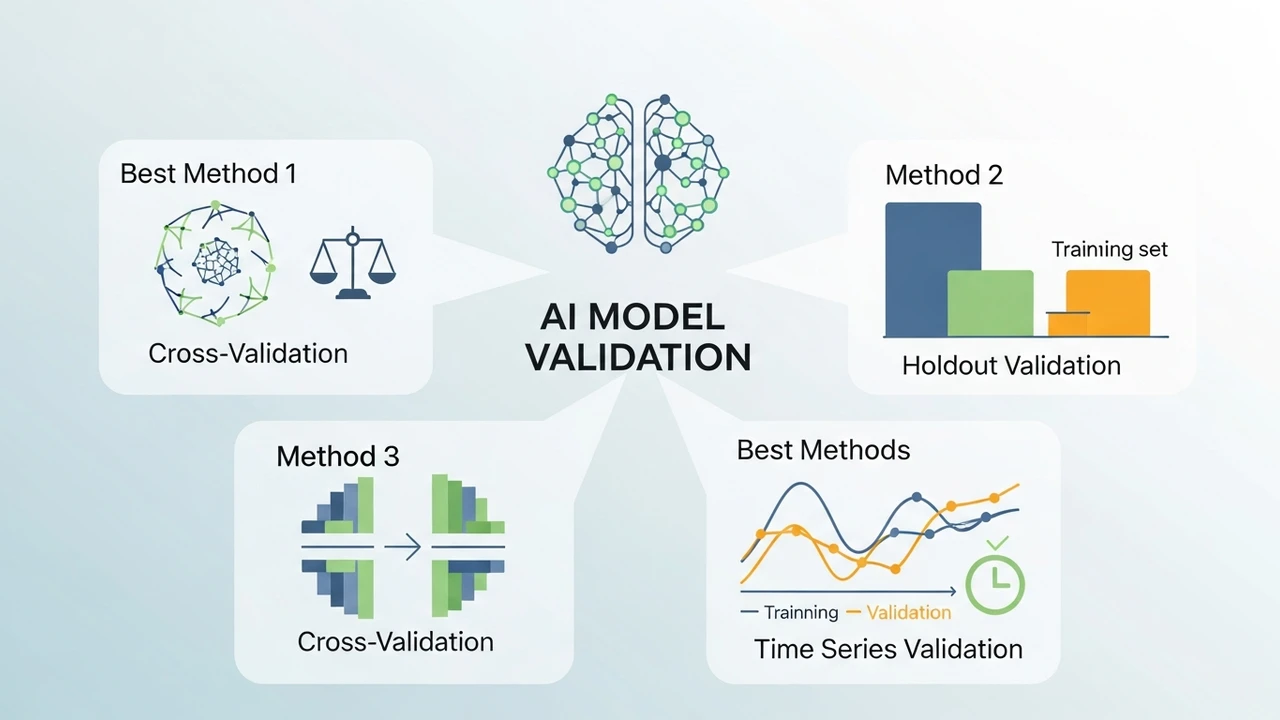
Compare the 3 most reliable methods for validating AI models in clinical settings.
Compare the 3 most reliable methods for validating AI models in clinical settings.
3 Best Methods for AI Model Validation
So, you have built an incredible AI model for healthcare. It looks great on your training data, the accuracy scores are through the roof, and your team is ready to deploy it in a real hospital. But wait—before you let that algorithm touch a single patient record, we need to talk about validation. In the world of AI healthcare and biotechnology, a model that works in a lab can be a disaster in a clinic if it hasn't been rigorously tested. Validation isn't just a box-ticking exercise; it is the safety net that ensures your AI actually helps people instead of causing harm.
Cross Validation Techniques for Clinical AI Models
The first method we need to dive into is K-Fold Cross Validation. If you are working with smaller, high-quality clinical datasets, this is your best friend. Instead of just splitting your data into one training set and one test set, you divide the data into 'K' equal parts. You train the model on K-1 parts and test it on the remaining part, repeating this process until every piece of data has been used for testing. This gives you a much more robust estimate of how your model will perform on unseen data. It is particularly useful when you are dealing with rare disease datasets where every single data point is precious. By using this method, you avoid the trap of overfitting, which is the number one killer of medical AI projects.
External Validation and Multi-Center Testing
Now, let's talk about the gold standard: External Validation. You might have a model that performs perfectly on data from a top-tier hospital in Boston, but what happens when you move that same model to a rural clinic in Southeast Asia? The patient demographics, the imaging equipment, and even the way doctors input data can be completely different. This is where multi-center validation comes in. You need to test your model on data from different institutions that were not involved in the initial training. This proves that your model is generalizable and not just memorizing the quirks of one specific hospital's database. If your model can handle the 'noise' of different clinical environments, you know you have a winner.
Prospective Clinical Trials for AI Performance
Finally, we have the most rigorous method: Prospective Clinical Trials. This is where you stop looking at historical data and start testing the AI in real-time. You integrate the tool into the actual clinical workflow and observe how it performs alongside human clinicians. This is the only way to truly measure the 'human-in-the-loop' impact. Does the AI actually save time? Does it reduce diagnostic errors? Or does it just add more screen time for the doctor? This method is expensive and time-consuming, but it is the only way to get regulatory approval from bodies like the FDA or local health authorities in Southeast Asia.
Top AI Validation Tools and Platforms
If you are looking for tools to help with this, there are a few standouts. First, there is Weights & Biases, which is fantastic for tracking your model experiments and ensuring reproducibility. It is widely used in biotech for managing complex datasets. Then you have H2O.ai, which offers excellent automated machine learning and validation features that are very popular in large-scale hospital deployments. For those focused on medical imaging, MONAI (Medical Open Network for AI) is an absolute must-have. It is built specifically for healthcare and provides specialized validation metrics for 3D medical images. Pricing for these tools varies; Weights & Biases has a generous free tier for researchers, while enterprise versions of H2O can run into the tens of thousands of dollars depending on the scale of your deployment.
Comparing Validation Approaches for Healthcare AI
When you compare these methods, it really comes down to your stage of development. Cross-validation is for the early research phase. External validation is for the pre-deployment phase. Prospective trials are for the final validation before full-scale rollout. You cannot skip these steps. If you try to rush a model into production without external validation, you are essentially gambling with patient safety. Always remember that in healthcare, the cost of a false negative is not just a lower accuracy score—it is a missed diagnosis that could change a patient's life forever. Keep your validation rigorous, keep your data diverse, and always keep the patient at the center of your development process.
:max_bytes(150000):strip_icc()/277019-baked-pork-chops-with-cream-of-mushroom-soup-DDMFS-beauty-4x3-BG-7505-5762b731cf30447d9cbbbbbf387beafa.jpg)