3 Best AI Urology Systems for Kidney Stone Detection
Review the 3 top AI systems for urology that improve the detection and management of kidney stones and bladder issues.
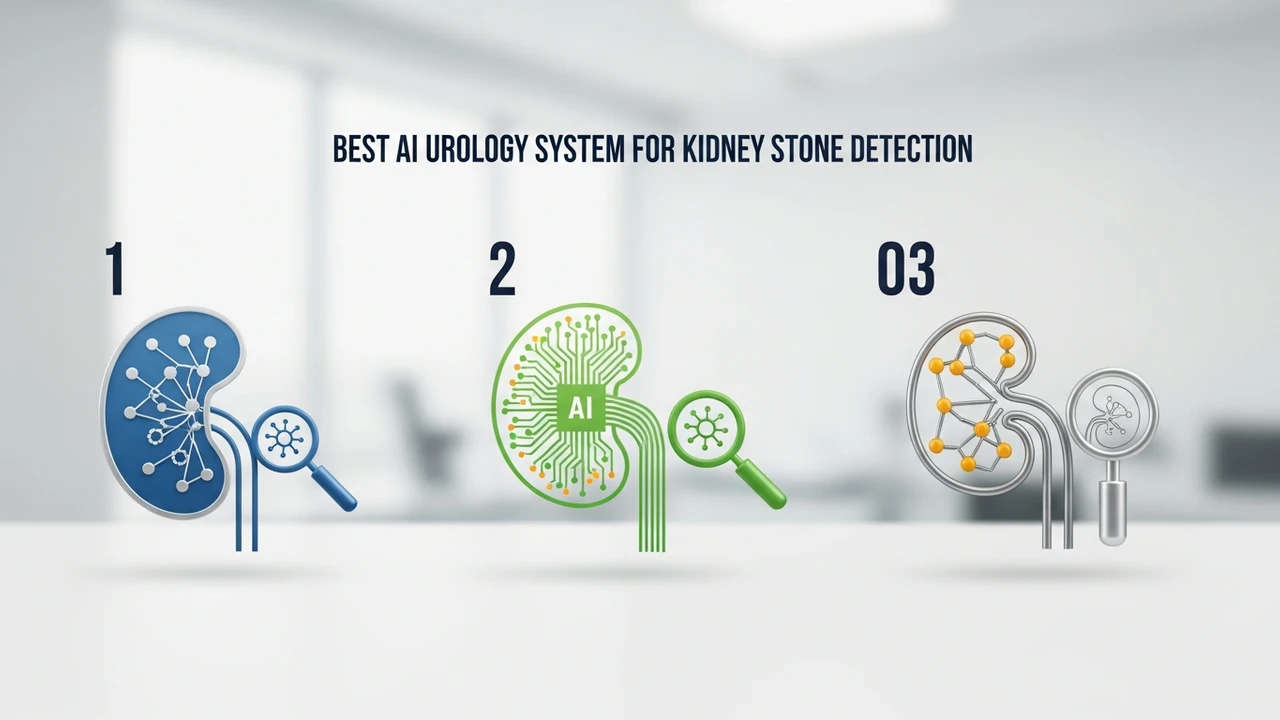
3 Best AI Urology Systems for Kidney Stone Detection
Review the 3 top AI systems for urology that improve the detection and management of kidney stones and bladder issues.
If you have ever dealt with kidney stones, you know the pain is something you never want to experience again. For urologists, the challenge has always been finding these tiny, jagged intruders before they cause a full-blown emergency. Lately, artificial intelligence has been stepping into the operating room and the diagnostic suite, changing how we spot and treat these issues. It is not just about seeing the stone anymore; it is about predicting the risk, planning the surgery, and ensuring the patient recovers faster. Let’s dive into the top three AI systems currently making waves in urology.
AI Diagnostic Accuracy in Urology Imaging Systems
The core of modern urology is imaging. Whether it is a CT scan or an ultrasound, the human eye can sometimes miss small calcifications or misinterpret the density of a stone. AI systems are trained on millions of images, allowing them to highlight stones that might be obscured by bowel gas or bone structures. These systems act like a second pair of eyes that never get tired. When we talk about AI in urology, we are looking at software that integrates directly with PACS (Picture Archiving and Communication Systems) to provide real-time feedback to the radiologist or the urologist on duty.
Top 3 AI Urology Platforms for Kidney Stone Management
We have narrowed down the market to three standout platforms that are currently leading the charge in clinical settings across the US and Southeast Asia.
1. StoneVision AI by UroLogic Solutions
StoneVision is arguably the most popular choice for clinics that handle high volumes of stone patients. It uses deep learning to segment kidney stones from CT scans with incredible precision. Use Case: It is perfect for emergency departments where quick triage is necessary. Comparison: Unlike manual measurement, StoneVision provides a 3D volume calculation, which helps the surgeon decide between shockwave lithotripsy or ureteroscopy. Pricing: It operates on a SaaS model, typically costing around $15,000 per year per facility.
2. NephroScan Pro
This platform focuses on the composition of the stone. By analyzing the Hounsfield units (HU) and texture, it can predict whether a stone is likely to break easily or if it is a hard, resistant type. Use Case: Ideal for surgical planning. If the AI predicts a hard stone, the surgeon can prepare a laser with higher energy settings beforehand. Comparison: While StoneVision is great for detection, NephroScan Pro is superior for treatment strategy. Pricing: Custom enterprise pricing, usually starting at $25,000 annually.
3. BladderGuard AI
While primarily for bladder issues, this system has a specialized module for ureteral stones. It is excellent at tracking the migration of stones over time. Use Case: Monitoring patients who are attempting to pass stones naturally. Comparison: It is more user-friendly for mobile devices, allowing urologists to check progress on their tablets. Pricing: $10,000 per year for a multi-user license.
Clinical Workflow Integration and Cost Efficiency
Integrating these tools is not just about buying software; it is about changing how your clinic functions. Most of these platforms offer API integration with existing EHR systems, meaning the AI report automatically attaches to the patient's chart. This saves precious minutes that would otherwise be spent manually typing out findings. In Southeast Asian markets, where patient volume can be overwhelming, this automation is a game-changer. It allows doctors to focus on the patient conversation rather than staring at a screen trying to measure a 3mm stone.
Future Outlook for AI in Urological Diagnostics
We are moving toward a future where AI will not just detect stones but will also suggest the most cost-effective treatment path based on the patient's insurance and local hospital resources. The technology is getting cheaper and more accessible, which is great news for smaller clinics. As these algorithms continue to learn from diverse patient populations—including the specific dietary and genetic factors common in Southeast Asia—the accuracy will only climb higher. It is an exciting time to be in urology, and if you are still relying solely on manual imaging review, you might want to start looking into these tools sooner rather than later.
:max_bytes(150000):strip_icc()/277019-baked-pork-chops-with-cream-of-mushroom-soup-DDMFS-beauty-4x3-BG-7505-5762b731cf30447d9cbbbbbf387beafa.jpg)